

Learning To Loiter: A Beginner’s Guide to Narrow Boating on the Oxford Canal
- Feb 1
- 9 min read
I’ll be honest: when my husband first suggested a narrowboat holiday on the Oxford canal in November, my initial response was a definitive ‘No way.’ My imagination conjured scenes of epic lock disasters; irritated seasoned boaters; and three nights of profound stress. Yet, weeks later, as I reluctantly tied up our hire boat for the last time, I realised I was loathed to leave it all behind. Our short trip hadn't just been a mini-break; it had been a recalibration - a much needed lesson in slowing down.
If you, like the pre-trip me, are a complete beginner, convinced that narrow boating will be complicated and stressful, let me reassure you. This is how my experience went, everything I learned, and how you can skip(per) making the same mistakes we did.
We began our journey at a boatyard just above the Isis Lock in central Oxford. Once we had unpacked our life into the compact, rather clever confines of the boat, the handover with the hire company began. It was an essential blur of engines, lock etiquette, and knots and when the instructor handed me the long wooden handle - that I now know to be called a tiller - and told me to drive, my heart raced more in tune with a speedboat than a narrowboat.
In my mid-life reality, I am used to things responding instantly. I click a button, and a package arrives; I send a text, and a problem is (theoretically) solved. I soon learned the hard way that a sixty-foot narrowboat does not subscribe to the on-demand economy. You push the tiller in the opposite direction of your desired turn, and you need to plan your manoeuvres several seconds in advance. It requires a level of foresight and ‘being in the moment’ that my fractured, multitasking brain had almost forgotten.
However with the speed dropped right down, and less panicked sweeps of the tiller from one side to the other, the boat began to respond and soon, my movements were intuitive. A gentle movement on the tiller, a slow correction, the quiet chug of the engine. Nothing about this was to do with speed or force; it was all about patience, trust, and finding a rhythm.
And then I needed to stop! ‘Where’s the brake?’ I asked our instructor, who was beginning to look like he wanted to be anywhere but here with me. ‘Reduce the throttle until you reach neutral,’ he said. ‘You can put her into reverse if you need to.’ And it really is as simple as that. Once the boat had stopped moving, I put her into the neutral position. That was that and the instructor stepped off – I’m sure he grimaced as I shouted ‘Ahoy’.
Being a writer, manual labour isn’t my strong point, and as we headed north up the canal on our own, I was secretly worried the locks would prove a bit too much like hard work. Fortunately I didn’t have much time to dwell as it wasn’t long before I was stepping off the boat with my windlass (lock key) in hand, leaving my husband to skipper.
The process is simple, but the mechanism sounds complicated: you use the windlass to crank a small pedestal on the bank that controls a paddle. This paddle opens a sluice in the side wall, which in turn floods the chamber with water. All that technical winding eventually leads to one satisfying moment: the physical act of pushing a huge wooden balance beam which opens the gate.
As I watched the water levels rise and fall, emails and work were the last things on my mind. I became entirely focused on this one task and there was something intensely gratifying about waiting for the water to level out, throwing my hips into the balance beam, and then watching our floating home glide into the chamber. For info, some of the locks differ; you’ll find some of the paddle mechanisms are on the gates themselves, meaning you need to cautiously walk the plank (the balance beam) to raise the second one.

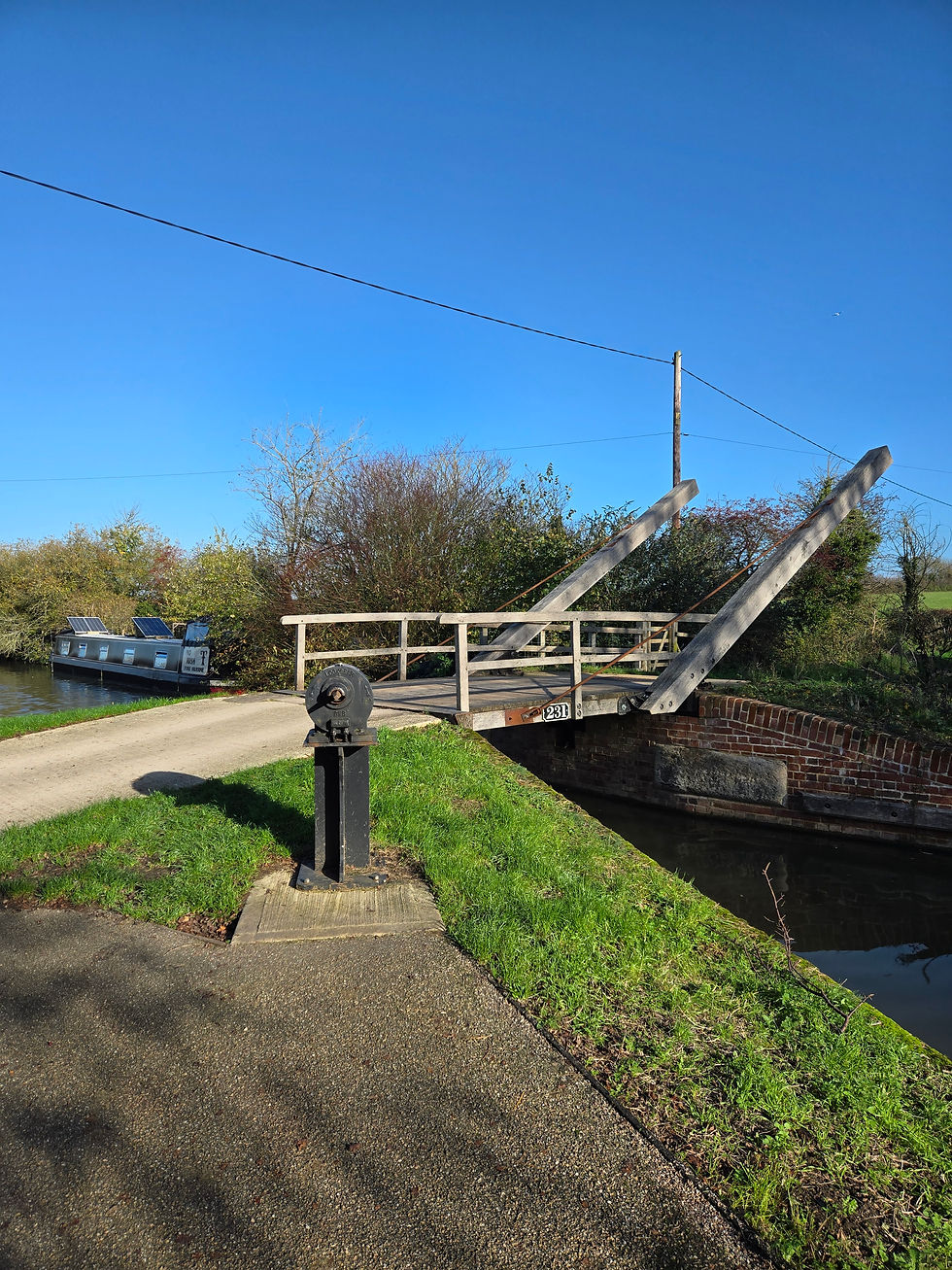
Amongst the locks, we encountered a unique feature of the Oxford Canal: lift bridges. This section of the canal has a fascinating history - it was authorised in 1769 to connect the Midlands to London, via the River Thames. Because it’s a contour canal, it simply follows the lay of the land, which explains its winding course, but the quirky bridges are actually a product of financial crisis! With budgets tight, expensive stone bridges were ditched in favour of cheaper, basically wooden draw bridges - to allow farmers to cross their fields.
To lift an accommodation bridge, you simply use the windlass to crank it up - making sure no one is about to cross, of course. Though some, like bridge number 230, first require a key to be inserted into a box located on the bridge itself. And, bridge 221 is electric which means you unlock the panel with your key and press and hold a button until the bridge is completely open (close the same way with the ‘close’ button). Once your boat has passed, close the bridge again to allow road traffic and walkers to cross.
Our first night saw us moor at a remote length of the canal with little but fields around us - though to be honest because we were boating in November (off peak season), the canal was pretty much ours anyway. At this time of year, the towpaths were hushed, the summer crowds replaced by the occasional dog walker, and there was a comforting smell of wood-smoke drifting from the chimneys of those who live-aboard. There was a quiet magic that magnified as the sun began its early afternoon retreat and the world shrank down to the warm glow of our cabin and the rhythmic psshh-psshh of water against the steel hull.
Our itinerary for the next day took us into the scenic winding wilds, culminating at a spot where the River Cherwell ducks gracefully under an iron bridge to merge with the canal (just below Bakers Lock - No. 40). This was our designated pivot point. Now, I wish I could spin you a yarn about how our vessel performed a flawless, elegant 180-degree Swan Lake-like ballet in the winding hole. But I'd be lying. It was less ‘ballet’ and more ‘hip-hop’. The manual suggests you should ‘ease off the throttle as you approach the winding hole’ to maintain full control of your vessel and point your bow (that’s the pointy front bit to us) towards the hole.
The reality? Well we attempted this and immediately shredded the theory when we found ourselves executing a perfect approach - toward the beautiful but unforgiving wall of the bridge.
The crisis was averted thanks to a few helpful, high-pitched yells from me of ‘REVERSE! THE OTHER REVERSE! NO, NOT THAT ONE!’. Skipper Husband (now sporting the stare of a man who had just mentally deducted the boat’s new wall-dent from our bank balance) skilfully wrenched the stern back into position and completed the turn. Not a single fender was harmed, though my vocal cords took a bit of a hit.
After that near-death experience, we deserved a drink and having passed through the picturesque village of Thrupp on our way up (and admired the picture-postcard, rose-covered terrace houses and two canal-side pubs), we knew exactly where to aim our now-wary bow on the return leg.
We managed to bag what we instantly declared the Platinum VIP Premium Mooring Spot: just metres from the Jolly Boatman pub. And you will be thrilled to know that we dedicated ourselves to rigorous research, sampling the beverages of both local public houses in the village.

Our final full day was set to be a serene, slow cruise, which included a relaxing, late breakfast. We decided to drive a little before deploying the culinary delight: a glorious, steaming bowl of hot porridge served on the bow (the pointy front bit, still).
‘How about pulling up here?’ Skipper Husband asked, eyeing a secluded, unofficial patch of banking. We weren't getting off, weren't stopping long - it was perfect! The throttle slowed, we gently edged... and then stopped with a soft, yet utterly decisive, thud.
‘We're stuck,’ declared Skipper.
‘Nonsense!’ I cheerfully retorted. ‘We are merely resting. But since we aren’t going anywhere, I’ll go and do the porridge.’
We then spent a thoroughly pleasant fifteen or so minutes consuming warm, comforting porridge, maintaining the polite fiction that we hadn't just accidentally run our floating hotel aground. It was the most British of stuck-situations.
Eventually though, reality demanded our attention.
To dramatically shorten our extensive, muddy, and genuinely embarrassing struggle: Our rescue plan involved long wooden ‘Escape Poles’ - found on the roof of the boat. But pushing the front free meant the rear got more stuck, and vice versa. It was like fighting a sticky, watery seesaw.
I have to hand it to Skipper Husband when he suggested we both push at the same time - me on the front, him on the back. It eventually worked! We cheered, gave the boat a celebratory throttle burst, and set off on our merry way.
But when we looked back, the long wooden pole was sticking upright out of the mud at a jaunty 45-degree angle, obstructing the canal like a defiant piece of avant-garde sculpture. There was no way we could leave it. We moored again (properly this time, because we learn quickly), and the heroic Skipper Husband set off on foot, armed with a metal hook and a dog lead, to retrieve the fallen warrior.
He returned victorious but muddy up to his knees and in a mood that could curdle milk.
Fortunately, it’s impossible to stay mad while cruising down such a beautiful canal. Everything looked fresh and new approaching it from the opposite direction, and very soon, the sight of that single, lonely pole was already making us laugh. Sometimes, the only thing better than a perfect voyage is a perfect disaster.
Our third and final mooring was strategically located a mere 30-minute cruise from the boatyard - close enough to Oxford to allow us to ditch the boat and return to the stable world of walking on land.
We strode across the Frenchay bridge like conquering heroes, ready to explore the edges of the city and take in the sights: independent delis, charming boutiques, and streets lined with houses so beautiful they made our narrowboat look like a muddy bathtub.
Our three nights on the Oxford canal were over far too quickly. I had arrived a nervous apprehensive beginner, afraid of damaging a beautiful boat and causing a major incident on a historic waterway. But I left feeling competent, rested and converted to the slow life.
The beauty of this mini break had been that whilst it was inherently active, it was utterly peaceful. Beyond the actual work involved in narrow boating, simple pleasures had proved immense and utterly unforgettable. During the day time we had been mesmerised by a magnificent heron, stock-still, just metres away, and I’ll never forget the enjoyment of nursing mugs of hot chocolate served with a side of swans and winter sun on the bow. Our evening reward for a day's travel had been silent, inky-black moorings where our only company had been the moon, the rhythmic water lapping against the hull, and a warming fire in the snug lounge. We came for the canals, but we stayed for the serenity.

If you’re on the fence because you think it might be too hard or … too slow, I’d suggest you sign up. The slowness isn't a drawback; it's a prescribed antidote to modern life. That initial difficulty? It’s a learning process that forces you to evolve from panicked passengers into a genuine, if slightly muddy, canal-command team. My advice? Let the waterway recalibrate your patience, mend your teamwork, and teach you the immeasurable value of a life lived at a stress-crushing 4 mph.
The Narrowboat Essentials
To help keep this blog afloat (pun absolutely intended), the below links in this post are affiliate links. This means if you decide to buy a pair of those life-saving waterproof gloves or a sturdy mug, I may earn a small commission at no extra cost to you.
If you’re ready to give it a try, a little preparation goes a long way.
For the physical work of the locks, a few pairs of grippy, waterproof work gloves is a godsend for protecting your hands from the cold, heavy windlass and the wooden balance beams.
Since an off-peak cruise is all about cozying up, we found that warmth was the key to maintaining morale. I’d suggest investing in a couple of insulated enamel mugs. They are virtually indestructible on a steel deck and keep your hot chocolate (or porridge) steaming far longer than a standard ceramic cup. And for those moments when you're standing at the tiller as the sun retreats, a rechargeable hand warmer in your coat pocket can be the difference between a serene cruise and a frozen one.
Finally, a sturdy pair of Wellington boots is non-negotiable for those muddy, celebratory pushes off the bank. Pair them with a high-powered LED headlamp for navigating back from the Jolly Boatman at night, and you’ll be more than ready.
The slowness is a privilege - so long as you have the right gear to enjoy it.


Comments